On Licona Muddying the Waters (2014)


On Licona Muddying the Waters

Norman Geisler

June 5, 2014


Cool, Clear Waters

Before Mike Licona wrote his recent article (June 2, 2014) “On Chicago’s Muddy Waters,” the waters were clear.  That is, the “Chicago Statement” on biblical inerrancy was clear on the meaning of inerrancy.  It affirmed that “dehistoricizing” sections of the Gospels, such as Licona has done, was contrary to inerrancy.  It declared that:

“We deny the legitimacy of any treatment of the text or quest for sources lying behind it that leads to relativizing, dehistoricizing, or discounting its teaching, or rejecting its claim to authorship” (Articles XVIII, emphasis added in all these quotes).


Article XIII declares emphatically: “We deny that generic categories which negate historicity may rightly be imposed on biblical narrativeswhich present themselves as factual.”


ICBI Hermeneutics Article XIV adds, “We deny that any event, discourse or saying reported in Scripture was invented by the biblical writers or by the traditions they incorporated.


Further, “We deny that extrabiblical views ever disprove the teaching of Scripture or hold priority over it” (Hemeneutics Statement, Article XX).

The official ICBI commentary adds, “Though the Bible is indeed redemptivehistory, it is also redemptive history, and this means that the acts of salvation wrought by God actually occurred in the space-time world” (Commentary on Article XII).


Cool, Clear Framers Agree

All living framers (R.C. Sproul, J.I. Packer, and N.L. Geisler) agree that ICBI excludes a view like Licona embraced in his book (The Resurrection of Jesus,185-187; 530, 548, 552,553).


R.C. Sproul declared clearly and emphatically: “As the former and only president of ICBI during its tenure and as the original framer of the Affirmations and Denials of the Chicago Statement on Inerrancy, I can say categorically that Mr. Michael Licona’s views are not even remotely compatible with the unified Statement of ICBI” (Letter, May 22, 2012).  He added, “You can use this comment by me however you wish” (emphasis added).


J.I. Packer added plainly: that “As a framer of the ICBI statement on biblical inerrancy who once studied Greco-Roman literature at advanced level, I judge Mike Licona’s view that, because the Gospels are semi-biographical, details of their narratives may be regarded as legendary and factually erroneous, to be both academically and theologically unsound”(Letter, May 8, 2014, emphasis added).


Norman L. Geisler: I have spoken repeatedly of the similarity of Licona’s views with those of Robert Gundry who was asked to resign (in 1983) from the Evangelical Theological Society (ETS) by an overwhelming 74% vote.  No attempt to minimize this vote can negate its legitimacy, clarity, or finality, no matter how much some may wish to do so. What could be clearer than the ICBI statements on this matter and the clear and emphatic words of the only living framers of the ICBI statements?


Casting Mud at Defenders of the ICBI Statement


If any waters have been muddied, it is from the mud cast at the defenders of the Chicago Statement on inerrancy.  They call the ICBI defenders “New Fundamentalist” eight times in Licona’s short article. They insist we are “rigid” and engage in “ferocious fratricide.”  They are designated inerrancy “police” or “police officers” who have a “most wanted” list.  They consider an inerrancy defender a “tar baby.”  They “politicize” this issue.  He even goes so far as to question our “motives,” rather than be content with evaluating our statements.


Licona and his supporters believe we engaged in a personal “crusade” against Licona.  In what seemed like a kind of doctrinal paranoia, Licona falsely claims Geisler is “criticizing me” or a “crusade against me” (twice, emphasis mine). He said, “I’ve been in the crosshairs of Norman Geisler,” as though he was a special target I wanted to kill.  The truth is we have never attacked him as a person, but only his views. I have said many times that I like Mike as a person and love him as a brother in Christ. However, we try never to put fraternity over orthodoxy or cloud our love for God’s truth by how nice a guy is or how good a friend the person is.  This cannot be said of Licona or his friends for their writings are toxic with personal attacks. One can look to Craig Blomberg’s recent book to illustrate the point.


Craig Blomberg, engaged without substantiation in a tirade in print against defenders of ICBI inerrancy (see his Can We Still Believe the Bible?)  He insists that we are “very conservative” (B, 7), “overly conservative” (B, 217), “ultra conservative” (B, 11, 214), “hyperconservative” (B, 13), “extremely conservative” (B, 7).  Of course, this tends to make his views look more moderate by comparison, when, as we shall see, they are in direct opposition to the mainstream evangelical view as reflected in the ICBI statements.  Blomberg even likens ICBI defenders of inerrancy to the extreme views Nazism and Communism (B, 8)!  He quotes with approval the statement, “the far left and the far right—avoid them both, like the plague” (B, 8). He claims that we “simplistically” distorted the evidence in order to oust Robert Gundry from the Evangelical Theological Society (B, 167).  He charges that we engaged in a “political campaign” against Gundry (B, 167).  Elsewhere, he alleges that we have utilized a “standard ploy throughout his [Geisler’s] career” when “trying to get someone removed from an organization” (B, 262 n. 111).  He adds the allegation that inerrancy is used as “a blunt tool to hammer into submission people whose interpretation of passages differs from ours…” (B, 125).  These charges of an alleged sinister and continuous career of unjustified activity on my part are both untrue, unjustified, and unethical.  Someone has rightly asked why it is that those who defend inerrancy are attacked and those who attack inerrancy are defended.


When mud-slinging occurs one can be reasonably sure that the attackers have run out of reasons and evidence to use in a rational argument and, thus, have resorted to attacking the person instead of the argument.


Muddying the Chicago Waters


Licona and his colleagues have insisted on muddying the Chicago ICBI waters by claiming the ICBI position is not clear.  They have charged that:

There are other interpretations of the ICBI Statements on Inerrancy.


Of course there are, no one disputes this.  However, that is not the question.  The question is: Are there better ones?  Do they correspond with the meaning expressed by the Framers of the ICBI statements?  The answer is an emphatic “No.” the Framers have spoken in commentaries and letters (see above).


Further, the “other” interpretations are not supported by the historical evidence (see Mark Hannah, The Church and Inerrancy).  Church history is virtually unanimous on the orthodox view of inerrancy.  It is unlimited inerrancy as expressed by the ICBI statements (see John Woodbridge, A Critique of The Roger/McKim Proposal).


What is more, I know of no other inerrancy statement ever made that was the work of some 300 interdenominational and international scholars that is more extensive and more complete and has been more widely accepted as that of the ICBI. Even the membership of the largest body of evangelical scholars who believe in inerrancy, the Evangelical theological Society (ETS), consisting of over 3000 members, adopted the ICBI statement as the definition of their brief inerrancy statement by an overwhelming 80% vote (in 2006).  If Mr. Licona and his New Testament critical friends think they can improve upon it, let them try.


The Chicago Statement is not a Creed.  Of course it isn’t, and it does not claim to be. That does not keep it from being a very good statement, or even the best one produced by a broad group of scholars to date. Nor does it hinder it from being right when it condemns “dehistoricizing” the Gospels as many critical scholars are doing today (see citations above).


The Chicago Statement is too “Conservative.”  It all depends where one is standing.  This is a relative term.  If one is already standing left of Scripture, then no doubt ICBI will seem too conservative.  However, when judged by the views of the Fathers of the Church from the earliest times down to and through the reformation to modern times (see John Hannah,Inerrancy and the Church, Moody, 1984),   the Chicago Statement is on target.  In fact, it is the Licona Neoevanglical view of Scripture that is too “Liberal.”

The Lausanne Covenant Statement on Inerrancy is more widely Accepted.  There is no comparison between Lausanne and Chicago statements on inerrancy.  Lausanne has only a brief statement on inerrancy as follows: “We affirm the divine inspiration, truthfulness and authority of both Old and New Testament Scriptures in their entirety as the only written word of God, without error in all that it affirms, and the only infallible rule of faith and practice” (1974). The Chicago statement is a more comprehensive statement containing numerous Affirmations and Denials. Indeed, there are two major statements with accompanying commentaries. The ICBI conference, unlike Lausanne, focused only on inerrancy and consisted of scholars trained on the topic.  So, for a detailed statement on inerrancy, the ICBI statement has been the most widely disseminated, embracing the 3000 members of the ETS and influencing numerous denominations, including the largest Protestant denomination in the world—the Southern Baptist Convention.


It is noteworthy that Billy Graham signed the Lausanne statement on inerrancy.  However, he also gave money to help start the International Council on Biblical Inerrancy which produced the Chicago Statements on inerrancy. And more recently, both Billy and his son Franklin Graham made statements in support of inerrancy on the www.DefendingInerrancy.com web site.  In fact, the world-wide circulation of Billy Graham’s magazine Decision(May, 2014) on “the dangers of compromise” featured an article defending ICBI inerrancy by the former president of the Evangelical Theological Society.


Many Books Defending ICBI Inerrancy were not published by Standard Publishers.

This is an irrelevant and misleading charge for several reasons.  First, numerous books defending ICBI inerrancy have been published through standard publishers.  To name only a few: The Erosion of Inerrancy in Evangelicalism by B. K. Beale; Defending Inerrancy by myself and William Roach; A Critique of  The Roger/McKim Proposal by John Woodbridge;  Indeed, the ICBI itself produced many volumes defending inerrancy all of which were published by standard publishers (like Zondervan, Baker, and Moody).  These include: Inerrancy, Biblical Errancy: Its Philosophical Roots; The Church and Inerrancy; Hermeneutics, Inerrancy, and the Bible.

Second, this charge is amazing since Licona was able to divine the reason for ICBI inerrantists using a non-standard publisher (like Xulon) was that we “could not find an interested publisher.”  As most writers know, there are other reason for using non-standard publishers as well, including time, money, control of the content, and owning the rights.  And there are also reasons to reject some “standard” publishers who would have published it.

Second, this objection assumes that truth is conveyed best, if not exclusively, by what they view as “standard” publishers. This supports a kind of professional elitism and academic snobbery. Truth is what corresponds to reality no matter who publishes it.

Third, this charge is amusing and ironic since the recent book attacking ICBI inerrancy which was blessed by Licona and many of his New Testament critic friends was self published by Licona’s son-in-law and his friend!


Many Muddy Statements by Licona


Licona and friends have made many statements that are clearly not traditional orthodox views on Scripture.  They include the following:

(1) Licona charges that we believe the Gospels speak with “legal precision” or “photographcic accuracy.”  The Chicago Statement spoke directly to this point, saying, “We further deny that inerrancy is negated by biblical phenomena such as lack of modern technical precision…and round numbers, the topical arrangement of material…or the use of free citations” (Article XIII).

(2) He believes there are or may be errors in the Gospels, for example: (a) on the report about when Jarius daughter died; (2) on whether the centurion made his request in person to Jesus; (c) whether the woman anointed Jesus two days before the Passover.

(3) Licona even goes so far as to affirm there is an error in the Gospels regarding on which day Jesus was crucified. He said “Jesus may have changed the day and time of Jesus’ crucifixion in order to make a theological point.”  Earlier in a debate with Bart Ehrman at Southern Evangelical Seminary (Spring, 2009) he said, “I think that John probably altered the day [of Jesus’ crucifixion] in order for a theological—to make a theological point there.”

But this is clearly contrary to the ICBI view of inerrancy which demands “the unity and internal consistency of Scripture” (Article XIV).  Also, “We deny that later revelations…ever contradict it” (Article 5).  We affirm the unity, harmony, and consistency of Scripture…. We deny that Scripture may be interpreted in such a way as to suggest that one passage corrects or militates against another” (Hermeneutics Article XVII).  WE affirm that since God is the author of all truth, all truths, biblical and extrabiblical, are consistent and cohere…” (Hermeneutics Article XX).

(4)  Licona affirmed that Joseph Holden, president of Veritas Evangelical Seminary dismissed Gary Habermas and Paul Copan as Adjunct faculty members because “they denied the inerrancy of the Bible on account of their failure to condemn the interpretation of Matthew’s raised saints” (Note 6).  President Holden affirmed in a letter (June 2, 2014) that this is false.  Holden wrote, “In the footnotes, it says I dismissed Habermas and Copan for their support of Licona and failure to condemn his interpretation of Matthew’s raised saints. When in fact, they were dismissed because of their own expressed view of inerrancy that became apparent in their defense of Licona.”

(5) Licona also wrongly affirmed that I was the founder of Veritas Evangelical Seminary.  I was not.  It was Joe Holden’s idea and he asked me to join with him and be a co-founder of the Seminary.

(6)  Licona affirmed that I refused to attend a particular panel discussion.  In any event, one cannot help but be impressed with the quasi-omniscient powers of critics who can read another’s mind.  This leads to arrogant charges like the following: Licona asserted that “In Geisler’s mind, there is no need for discussion in an academic forum because he apparently thinks he already knows the correct answers; all of them.”  I have participated in untold academic discussions and debates over the last fifty years, so I have learned to pick carefully the ones in which I participate.


(7) He alleged that we never offered a solution to the alleged contradictions he raised in the Gospels.  This too is false.  I have presented it many times in official presentations on alleged contradictions in the Bible.  Further, it is in one of the “20 articles” Licona said I wrote on the issue, titled “Mike Licona Admits Contradiction in the Gospels” (January 2013) which he apparently did not read.


(8) He claims that “Many of the original signers [of the ICBI Statement on Inerrancy] do not agree with how Geisler and others interpret it.”  In response, two brief comments are in order.  First, even according to Licona, the true meaning of a text is in the “intention” of the framers, not the signers.  Second, all living framers (see above) agree on its meaning, especially as it applies to Licona’s view.  So, it is not just my view on the matter.


(9) ICBI view of Inerrancy actually undermines Inerrancy.  By a strange twist of logic Licona argues that the ICBI view of inerrancy actually undermines the authority of the Bible because showing one error overthrows the Faith.


First, by this same logic people should not believe Christ rose from the dead since a sophisticated naturalist might convince them that miracles are not credible. Or, people should not believe God exists since a sharp atheism might convince them that He does not exist.

Further, this objection confuses reliability and inerrancy.   If a critic could prove (and none have) one real error in the Bible it would overthrow the ICBIview of inerrancy, but it would not overthrow the Faith.


Inerrancy is to be distinguished from the reliability of the Bible.  My CPA is a very accurate book keeper.  But if he made one mistake in math that would not overthrow his reliability. On the other hand, if he claimed divine authority and inerrancy, then one error would overthrow his claim to divine authoritybecause God cannot make even one mistake (Heb. 6:18; Titus 1:2; John 17:17).


This is what B.B.Warfied meant, and Licona misunderstands.  For Warfield too believed that the Bible was divinely authoritative and inerrant and, as such, one error would destroy that divine authority/inerrancy. However, it would not overthrow the Faith since the Faith could be true apart from inerrancy.  Inerrancy is not a test of evangelical authenticity but of evangelical consistency.  Licona confuses Warfield’s apologetics and his theology.  Warfield used apologetics (based on the evidence to show thereliability of the Bible). But once he knew from good reason that the Bible was more than reliable; it was the inerrant Word of God, then Warfield believed that only an inspired and inerrant Word of God is an adequate basis for our belief in the divine authority of the doctrines of the Bible.


So, likewise, Licona misinterprets our statement about inerrancy being a “fundamental” of the Faith.  We said clearly that it is not a doctrinal or theological fundamental; it was an epistemological fundamental. For without an inerrant Bible we have no divinely authoritative basis for our Faith.


(10)  Licona also makes other statements that are seriously mistakes.  One is that (a) “the doctrines of the divine inspiration and inerrancy of the Gospels are faith doctrines that cannot be proven.” (b) Another is that a historian should be “making no theological assumptions pertaining to whether they [the Gospels] are divinely inspired or inerrant.”  These are both based on Licona’s admission that he (c) “unashamedly confess[es] the historical critical method.”  Given that Licona sees Genre criticism as part of this endeavor, no wonder he can believe in contradictions in the Gospels (see above) and say “Bioi offered the ancient biographers great flexibility for rearranging material and inventing speeches,…and they often included legend.  Because bios was a flexible genre, it is often difficult to determine where history ends and legend begins” (The Resurrection of Jesus, 34, emphasis added).


(11)  Licona contends that “biblical inerrancy is a secondary or tertiary doctrine.” Statements like this show a serious lack of understanding and appreciation for the doctrine of divine inspiration which entails inerrancy as a necessary concomitant.  For a divinely inspired error is nonsense. If the Bible is the Word of God, and that is what divine inspiration means, then it is inerrant.  For God cannot error. So, to attribute error to God’s Word is to attribute error to God Himself.  As John Calvin affirmed, “our faith in doctrine is not established until we have a perfect conviction that God is its author.  Hence, the highest proof of Scripture is uniformly taken from the character of him whose word it is” (Institutes 1.7.4).


(12) Licona criticized me for twisting the arms of other seminary presidents. This reckless charge misrepresents the facts. At the same time, he has attempted unsuccessfully to convince some of the orthodoxy of his view.  He even made a yet unadmitted trip of some distance to try to convince one influential Christian leader of the orthodoxy of his unorthodox view—only to be unsuccessful. Another one even set up a forum for him to express his view, after which the Seminary president said he would not hire him on his faculty.  Liconna tried to convince a third seminary to accept his view, after which they dropped him from their Adjunct Faculty. One faculty member who attended the meeting said, “It was worse than I thought.” Yet I did not contact a single seminary and ask them to reject Licona from their faculty. Nor did I “turn” to seminary presidents “to come out publicly” against him when I could no longer get enough high-caliber scholars to speak against his view.


Furthermore, this accusation is an insult to the integrity and autonomy of these different seminary leaders.  As for asking others to support the inerrancy cause, of course we do, as do those who oppose it.  In fact, we have a web site dedicated to it defending inerrancy (www.defendingInerrancy.com). Licona’s son-in-law has a web site dedicated to attacking me regularly by name and even making an insulting video for YouTube with Licona’s blessing. Anyone who examines the two approaches can see the difference.


(13) He rejected (without giving any evidence) the strong case we made for all the main orthodox Fathers of the Church between the apostles and the Reformers of holding that the story of the resurrected saints in Matthew 27:51-53 as being history not poetry or legend (see “The Early Fathers and the Resurrection of the Saints in Matthew 27” athttp://normangeisler.net/articles/Bible/Inspiration-Inerrancy/Licona/Early%20Fathers%20on%20Matthew%2027.pdf).  Just to cite a couple examples:


Irenaeus (AD 120-200), who knew Polycarp, a disciple of the apostle John,

wrote:


…He [Christ] suffered who can lead those souls aloft that followed His ascension.  This event was also an indication of the fact that when the holy hour of Christ descended [to Hades], many souls ascended and were seen in their bodies (Fragments from the Lost Writings of Irenaeus XXVIII, Ante-Nicene Fathers, vol. I, Alexander Roberts, ibid., 572-573).


Even Origen (AD 185-254), who had the Neoplatonic tendency to spiritualize literal events, believed Matthew 27 was literal history, declaring:

“But,” continues Celsus, “what great deeds did Jesus perform as being a God?…Now to this question, although we are able to show the striking and miraculous character of the events which befell Him, yet from what other source can we furnish an answer than the Gospel narratives, which state that ‘there was an earth quake, and that the rock were split asunder, and the tombs were opened, and the veil of the temple was rent in twain from top to bottom, an the darkness prevailed in the day-time, the sun failing to give light” (Against Celsus, Book II, XXXIII. Alexander Roberts, ed. Ante-Nicene Fathers, vol. 4, 444-445).


St. Augustine (A. D. 3546-430), the greatest biblical theologian of his time, wrote:


“As if Moses’ body could not have been hid somewhere…and be raised up therefrom by divine power at the time when Elias and he were seen with Christ: Just as at the time of Christ’s passion many bodies of the saints arose, and after his resurrection appeared, according to the Scriptures, to many in the holy city” (Augustine, On the Gospel of St. John, Tractate cxxiv, 3, Philip Schaff, Nicene and Post-Nicene Fathers, vol. VII, 448).


John Calvin (1509-1564) added,


“Yet we may doubt whether this opening of the tombs happened before the resurrection, for the resurrection of the saints which is shortly after added followed in my opinion the resurrection of Christ.  It is absurd for some interpreters to image that they spent three days alive and breathing, hidden in tombs.”  For “It seems likely to me that at Christ’s death the tombs at once opened; at His resurrection some of the godly men received breath and came out and were seen in the city.  Christ is called the Firstborn from the dead (1 Cor. 15:20; Col. 1:18” (Calvin’s New Testament Commentaries, vol. 3, pp. 211-212).


These kinds of statements are found to and through the Reformation to modern times.  So, those who deny the historicity of this Matthew 27 passage on the saint’s resurrection have virtually the whole of the history of the Christian Church against them.


Conclusion


Mike Licona wrote his recent article (June 2, 2014) on “Chicago’s Muddy Waters.”  But it was not the Chicago Statement or the interpretation of it by the living Framers that muddied the waters.  This represents the crystal clear evangelical view down through the centuries of full inerrancy and complete historicity of the Bible.  To be sure, the waters have been muddied, but they were muddied by New Evangelical scholars like Licona who have adopted the New Historical Critical method and have become New Evangelicals or Neoevangelical on their view of Scripture, creating a New “battle for the Bible.”


This leaves us with the conclusion that the ICBI statement represents the biblical view of inerrancy which we call the evangelical view.  Hence, since Licona and his supporters, whom he lists as  Darrel Bock, Dan Wallace, Craig Blomberg, Michael Bird, William Lane Craig, Jeremy Evans, Craig Keener, Lee McDonald, Kevin Vanhoozer, Robert Yarborough, and Gary Habermas) embrace a new kind of evangelicalism–a Neoevangelicalism–with regard to Scripture, which has been its label now for a generation.  It is definitely not the biblical or traditional view, hence, its view of Scripture has no rights to the use the unqualified term “Evangelical.”  It is more properly described as Neoevangelical.  While Licona and Bird would have us believe that they are fighting the barbarians at the gates of the city, in actuality they are escorting the Trojan horse of the barbarians through the gates and deep into the city.
Does Diversity in Protestantism Support the Roman Catholic Position to be the one true Church?


Does Diversity in Protestantism Support

the Roman Catholic Position to be the one true Church?

Norman L. Geisler

Roman Catholic apologists have long argued that the vast diversity among churches is evidence of the need for the Roman Catholic authority in the church over against all the non-Catholic splinter groups including evangelical Protestants of various varieties.  On the surface, there is a certain plausibility in their complaint that behooves further scrutiny.  However, before one swims the Tiber, several things should be taken into consideration.

First, there is an important difference between true spiritual unity and organizational uniformity.  The Roman Catholic Church is an organization—a large and world-wide organization to be sure.  Nevertheless, it is an organization, with a headquarters, a charter, and a hierarchy of officials.  However, all of this would be possible without a true doctrinal, ethical, and spiritual unity.  So, even if the Roman organization is a descendent of the one Christ started, this would not prove in itself that it has preserved the truth and spiritual heritage which Christ had initiated.

For example, the present United States government is the organizational descendent of the First Continental Congress, but knowledgeable people recognized that it has come a long way from the founders in many of its beliefs.  The permission of slavery and forbidding of women to vote are only two such differences.  So, even if there was an organizational identity between the New Testament Church and the present Roman Catholic Church, it would not prove there was a doctrinal, moral, and spiritual unity between them.

Second, even in New Testament times, the split between Peter and Paul reveals that opposition to Peter—heralded by Rome as the first pope—was an important element in the development of the catholicity (universality) of the church.  As noted church historian Jaroslav Pelikan, put it, “to become catholic [universal] the church had to oppose Peter” (The Riddle of Roman Catholicism, 24).  For Christ command to disciple “all nations’’ (Mt. 28:18-20), and the vision of Pentecost (Acts 2), involving the outpouring of the Spirit on people from all nations, was hindered by Peter’s reluctance to see the spiritual equality of Jew and Gentile (Acts 10).  This came to a climax in Acts 15 when at what has been called “the first church council” the matter of the catholicity of the church, with Jew and Gentile, was pronounced by the apostles and leaders of the church.  So, if anything, the first alleged Pope of the Catholic Church (Peter) had to be rebuked by the apostle Paul (Gal. 1), divinely prodded by three visions, and overruled  by the first New Testament church gathering (Acts 15) opposed to make the church truly catholic.

Third, there is no evidence of an organization continuity between the Church at Rome and the current Roman Catholic Church.  The first church was not in Rome; it was in Jerusalem (Act 2).  In fact there was a church in Antioch (Acts 13:1) before there was one in Rome (Romans 1:1; 16:23). So, if antiquity counts for continuity, then there was a church in the East before there was one in the West.  By this reasoning, priority would be given the Eastern Orthodoxy, not Roman Catholicity.  The dominance of Rome was political, not biblical.  So, if anything Rome was a branch from the church in the East , not the reverse.

Fourth, the biggest splits in Christendom happened under the domination of the Roman Church.  The split with Eastern orthodoxy in the 11th century occurred as a result of Rome’s action, not a break off from the East. Pope Nicolas I (d. 867) deposed the Patriarch of Constantinople, Photius (d. 891).  Later in 1204 a Latin Patriarch was established in Constantinople.

So, if having an infallible head, as Rome claims, should protect against splinters, then the first and biggest one happened on Rome’s watch—and largely as a result of their actions.  Likewise, the second biggest split in Christendom—the Protestant Reformation—also occurred while Rome was in charge of most of Christendom in the 16th century.  History records that Luther’s desire was not to start another church.  He wanted to purify the one that was there, namely, the Roman Catholic Church. And Luther did not leave the Catholic Church.  Rather, he was excommunicated from it.  So even a church united under a Roman Pope in the West could not stop the second biggest split in Christendom.

Fifth, numerous splits in Christendom occurred under Roman Popes, showing they were no guarantee against fragmentation in the church.  Indeed, theOxford Dictionary of the Christian Church lists over 35 anti-popes which means there were two infallible popes at the same time!  Sometimes one would infallibly excommunicate the other! This is historic proof that shelter under the Roman umbrella was no guarantee against the storms of disunity.  On one occasion there were three popes—the two who were feuding and the one which the Council of Constance (1413-1418) had to set up over them to resolve the conflict.

Sixth, even Rome, with its alleged infallible leadership, could not avert schisms or even heretical Popes.  Numerous cults and breakoffs from Rome occurred under the Roman reign.  The Arians and Donatists were notable among them.  And at one time the Arian Cult encompassed a large section of Christendom.  Pope Honorius was a heretic condemned by later ecclesiastic authorities. Certainly none of this was due to the Protestant Reformation.  And not all of it was due to the lack of a papal authority.  For, as just shown, much of it involved popes, anti-popes, and heretical popes.  One thing is certain, having an infallible pope was not a guarantee against theological splintering.  This is to say nothing of the thousands Christians Rome pronounced heretics and were martyred in the Inquisition!—one of the tragic events possible only in a totalitarian regime like Roman Catholicism.

Seventh, other than groups that are considered heretical by both Catholics and Protestants, there is doctrinal unity on all essential teachings among all the diverse orthodox churches in Protestant Christendom.  This unity is manifest in the first four centuries.  As it has been aptly codified: “One Bible; Two Testaments; Three Creeds: Apostles Creed, Nicene Creed, and the Chalcedonian Creed; Four Councils: Constantinople, Ephesus, Chalcendon; this doctrinal unity is truly evangelical.  The diversity of doctrines are largely on the non-essentials.  So, Lutheran, Presbyterian, Methodist, Baptist or whatever, there is an essential doctrinal unity, despite all the non-essential differences.

Diversity within unity is not necessarily bad.  Even Roman Catholicism itself has many diverse orders, some of which strongly opposed beliefs and practices of the other orders.  These bear some similarity to denominational difference among evangelical Christians.  Opposing all diversity is as boring as having only one make of cars or one brand of tooth paste.  Even the rainbow has many colors. The important thing was captured by Repertus Meldinius (d. 1651) when he wrote: “In essentials unity, in non-essentials, liberty, and in all things charity (love).”

Eighth, Jesus’ prayer for his disciples “that they all may be one” (Jn. 17:21) was clearly not a prayer for organizational uniformity.  Rather, it was forspiritual unity (“Just as you Father are in me, and I in You”—v. 21), such as there is in the Godhead.  Of course, Jesus wished that this relationship be visible to the world (v. 21) so that they would see the love of God and come to Christ (v. 23).  Indeed, the true unity is one body of Christ and it is made by God (1 Cor. 12:13; Eph. 4:4-5).  The church on earth is to be patterned after this and should endeavor to “maintain” a visible manifestation of it (Eph. 4:3).  So, His prayer was not ecumenical but practical.  It was not for a union of churches with each other, but a  unity of individuals with each other in Christ.

In summation, neither the New Testament no church history supports the Roman Catholic claim that the Roman Church, with its hierarchical structure, is the better guarantor of true spiritual unity.  While church splintering since the Reformation is far from commendable, neither is the larger and more serious divisions in and splits from the Roman Catholic Church on their watch.  However, organizational uniformity offered by Rome is not the true spiritual unity for which Christ prayed.


Dr. Geisler is the author of Should Old Aquinas Be Forgotten? Many Say Yes but the Author Says No. (Bastion Books:2013), What Augustine Says (Bastion Books:2013), Is the Pope Infallible: A Look at the Evidence (Bastion Books:2012), Is Rome the True Church? A Consideration of the Roman Catholic Claim (Crossway Books:2008), and Roman Catholics and Evangelicals: Agreements and Differences (Baker Academic:1995). For additional resources by Dr. Geisler on Roman Catholicism, please visit http://normangeisler.com/rcc/.

The Crusades: Were they Justified? (2015)


clip_image002


The Crusades: Were they Justified?

Norman L. Geisler

2015


Recently president Barak Obama made a moral comparison between the Crusades and recent attacks and atrocities of the Radical Islamic group called ISIS, known for beheading, crucifying, and even burning its captives. Not only is there no moral equivalence between the actions of the Crusades and ISIS, this comparison reveals a serious lack of understanding of the Crusades.

The Prologue to the Crusades

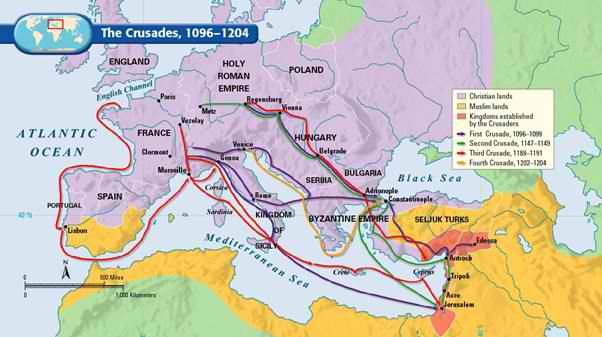
Between 1095 and 1400 there were some nine Crusades or expeditions of Western (European) Christians into the Eastern Mediterranean designed to recover the Holy Land from Muslim hands. These were encouraged by the Catholic Church and involved the death of thousands of people.

The Prologue to the Crusades: 500 Years of Muslim Advance

The Crusades can only properly be understood in terms of the 500 years of Muslim advance into the West that preceded them. Muhammad was born in A.D. 570 Mecca in present-day Saudi, Arabia. In 630 he led an army of 30,000 to conquer Mecca. By 711 Muslims took Syria, Iraq, Egypt and Jerusalem. By 732 they had invaded Spain and were turned back at Tours, France by Charles Martel. In 846 they attacked outlying areas of Rome. By the end of the 9th century Muslim pirates had established havens all along the Mediterranean coast, threatening commerce, communication, and pilgrim traffic for the next century. They controlled some 2/3 of Christendom. As a result, many Christians and Jews were enduring persecution at Muslim hands.


The Plea for the Crusades

By 1071 Eastern Christians sent appeals to the Western Christians for help. In 1095 Pope Urban II responded by calling on the Knights of Christendom to assist, and the first Crusade began what turned out to be a several hundred years of conflict.

The Purpose of the Crusades

Contrary to some modern secular charges, the Crusades were not colonial attempts to accumulate land and possessions. The primary purpose was spiritual. They wished to liberate the Christian captives from oppression by Muslims. Further, they desired to restore Christian access to the holy sites around Jerusalem. This is not to say that no unnecessary deaths and pillaging occurred. Regretfully, it did.  However, the primary purposes were noble.


The Participants of the Crusades

The Crusaders consisted of Western Christians who loved their fellow believers in the East many of whom had lost their homes, land, and even their lives. This opens the door to address several widely held myths about the Crusades that call for a response.


Myth #1: The Crusades were wars of unprovoked aggression

against a peaceful Muslim world minding its own business.

 The truth is that the Crusades were a reaction to 500 years of Muslim aggression into dominantly Christian countries. The Crusades were in essence a defensive action against the spread of Islam by the sword. They were undertaken largely out of concern for fellow Christians in the East. In fact, many great saints supported the Crusades, including Bernard of Clairvaux, Thomas Aquinas, and peace-loving Francis of Assisi. Troops prayed and fasted before battles and praised God after them. Even many Muslim respected the ideals of the Crusaders.

Of course, there were sins of overreactions by some Crusaders. But most of these were deeply regretted and forgiveness was sought by Christians who participated in them. Unfortunately, this was not so for Muslim exploiters who felt little remorse but looked to a future in Paradise as a reward for their endeavours in stomping out the infidels.

Myth # 2: The Crusades were colonialist imperialists after booty and land.

This charge is contrary to the facts of history. Most Crusaders undertook the 2000 mile trek at great sacrifice of their own wealth. Many sold or mortgaged their own homes, most of which were not recouped. Most never occupied the land they gained from the Muslims. They went out with a sense of duty to God.

Myth # 3: When the crusaders captured Jerusalem in 1099,

they massacred ruthlessly.

This criticism is overstated. Of course, people were killed, but it was not ruthless. It was usually in accord with the norms of war for that time. Cities that resisted were captured and subjugated to the captors, but inhabitants of cities that surrendered were not killed. However, the people who surrendered most often retained their property and worshiped freely (see SALVO, issue 27 [Winter, 2013], pp. 60-62).

The Perversion of the Crusades

If this is so, then why do most people today have a distorted view of the Crusades? It was not always so. During the Middle Ages nearly all Christians in Europe believed the Crusades were morally justified. The modern distortion of the Crusades began with French humanist Voltaire (1694-1778) who abhorred Christianity (see his Philosophical Dictionary). The contemporary anti-crusade stance was set by Sir Steven Runciman, A History of the Crusades (1951-1954) and popularized by a BBC/A&E documentary (1995).

Only recently has this negative attitude begun to be corrected. Professor Rodney Stark is a case in point. He wrote, “Not only had the Byzantines lost most of their empire; the enemy was at their gates.” Hence, “the popes, like most Christians, believed war against the Muslims to be justified partly because the latter had usurped by force lands which once belonged to Christians and partly because they abused the Christians over whom they ruled and such Christian lands as they could raid for slaves, plunder and the joys of destruction” (Rodney Stark, God’s Battalions: The Case for the Crusades (HarperOne, 2009), pp. 33, 248) Other authors have added to this re-evaluation of the Crusades (see also Thomas F. Madden, The New Concise History of the Crusades, Lanham, MD: Rowman & Littlefield. 2005).


Dr. Geisler is a philosopher, theologian, and ethicist who has authored two books devoted to the subject of ethics: The Christian Love Ethic (Bastion Books: 2012) and Christian Ethics: Contemporary Issues and Options (Baker Academic:1989, 2010)


Don’t Jump on Andy Stanley too Quickly (2015)


Don’t Jump on Andy Stanley too Quickly

By Norman L. Geisler

2015

 Recently (2/2015), Andy Stanley, well known contemporary Atlanta pastor, said that “The foundation of our faith is not the infallibility of the Bible.  The foundation of our faith is something that happened in History.  The issue is always, who is Jesus?  The Scripture is simply a collection of ancient documents that tells us that story.”

Some have jumped on Stanley for denying the infallibility of the Bible. However, at worst, these statements are unfortunate and incomplete but not explicitly heretical.  For, first of all, the Bible is not “simply a collection of ancient documents,” not in any absolute sense but only relatively as compared to Jesus as God incarnate.  At any rate, his statement as such is incomplete for the Bible is more than this.  The Bible is also the infallible and inerrant written Word of God.  But, as far as I know, Andy does not deny this either here or anywhere else.

Second, of course, theologically there is an important sense in which the Bible is the foundation of our faith.  For without it we have no divinely authoritative basis for what we believe.  However, Stanley is right in affirming that actually it was Christ, not the Bible, who procured our salvation by his death and resurrection (1 Cor. 15:1-6).  But this is not to say that the Bible in not an infallible written authority pointing us to Christ (Jn. 5:39).

Third, Andy goes on to say that he believes the Adam and Eve story, “not because the Bible says so, but because in the gospels, Jesus talks about Adam and Eve…. And if he [Jesus] believed they were historical, I believe they were historical, because anybody that can predict their own death and resurrection, and pull it off, I just believe anything they say….”  Some have jumped on Andy for this statement since they claim he doesn’t know this is true about Jesus except for the gospels.  However, this is not a circular argument since he is not assuming here that they are divinely inspired but only that we have good historical evidence that they are reliable. And if they are reliable, then Jesus’ affirmation is reliable when he pronounces that the Bible is more than merely reliable; it is the inspired Word of God (Mat. 5:18; Jn. 10:35).

In brief, Christ is the foundation of our faith ontologically (in reality).  However, the Bible is the only infallible foundation for what we believe epistemologically (how we know).  Historically, we have only reliable (not infallible) documents to support the claim that Jesus is God (and that he proved it miraculously) and, thus, he can be trusted when he affirmed that the Bible is the infallible and inerrant word of God. This is to say nothing of the fact that the Spirit of God confirms to us through the Bible that it is the Word of God (1 Jn. 5:9-11).

In short, Stanley’s presentation is theologically incomplete, but it is not technically incorrect. However, it would be wise to revise the statement that “the Bible is simply a collection of ancient documents” because It is more than a human book; it is divinely inspired. While at times Andy fails to clarify his contentions theologically, his main point can be verified apologetically as part of an overall argument from the evidence for the infallible Word of God.  This argument moves from historically reliable documents to the divine authority of Christ who (supported by miracles) affirmed the infallibility and inerrancy of Scripture.  Of course, this is not the only apologetic approach that can be taken on the topic. However, this classical type apologetic method has been used for nearly 2000 years by Christ (see our The Apologetics of Jesus, Baker, 2009), the apostles, Augustine, Anselm, Aquinas, C. S. Lewis, and R.C. Sproul.  So, with this approach, Stanley is in good theological company (see our Christian Apologetics, Baker, 2013).

Options in Contemporary Christian Ethics


The Christian Love Ethic (2012)
The Christian Ethic of Love (1973)
Options in Contemporary Ethics (1981)

Updated in 2012 and renamed to The Christian Love Ethic

http://bastionbooks.com/shop/the-christian-love-ethic/

The older versions can still be found here:

http://www.amazon.com/Christian-Ethic-Love-Norman-Geisler/dp/B003800LPI/ref=sr_1_2?s=books&ie=UTF8&qid=1331409120&sr=1-2

and here:

http://www.amazon.com/Options-Contemporary-Christian-Ethics-Geisler/dp/B000GSNUR6/ref=sr_1_57?ie=UTF8&qid=1331407772&sr=8-57

Baker’s Encyclopedia of Christian Apologetics (1999) / The Big Book of Apologetics (2012)


The Big Book of Christian Apologetics: An A to Z Guide (or “BOCA”) is a slightly updated (2012) and somewhat abridged version of The Baker Encyclopedia of Christian Apologetics (or “BECA,” 1999). Some footnotes were updated. BOCA has 674 pages and BECA has 864 pages.

Available at: BakerBooks.com and Christianbook.com

Can you explain your faith?

In our pluralistic, post-Christian world, the need to be able to clearly and confidently explain why you believe what you believe has never been greater.

The Big Book of Christian Apologetics is a comprehensive resource designed to equip you with information to help you defend and explain your faith to anyone, anywhere. Examining nearly every key issue, person, and concept related to Christian apologetics, this helpful book

  • clarifies difficult biblical passages
  • clearly explains various philosophical systems and concepts
  • examines contemporary issues and challenges
  • offers classic apologetic arguments

It gives you the background you need to intelligently and persuasively talk about your Christian faith with skeptics and seekers in private or in the public square.


Available through Amazon or Alibris

Silver Medallion Award winner

Weighing in at 850 pages, the monumental work has become a standard text in the field and one of the most comprehensive single volumes on apologetics.

“This is a remarkable book in both breadth and depth. I anticipate that it will often be the first reference work I turn to, and I will encourage my students to use it both for the articles and for the bibliographies.”

—Winfried Corduan, professor emeritus of philosophy and religion, Taylor University, Upland, Indiana

“Baker’s Encyclopedia of Christian Apologetics is just what we need. Its author adopts a modern form of Thomism, defending classical apologetics. Yet this work is clear and true-a fine resource for every defender of the faith.”

—David K. Clark, Ph.D.; Director of the Center for Biblical and Theological Foundations, Professor of Theology, Bethel Seminary

“This is an extraordinary helpful resource. A superb job by one of evangelicalism’s premier scholars.”

—Charles W. Colson, Prison Fellowship Ministries

“Nowhere will anyone find more apologetic information than in this volume. Time and again I was impressed with the sheer amount of data that Norm Geisler places at the fingertips of the student. This book will serve as the chief reference work in apologetics for years to come.”

—Gary R. Habermas, Distinguished Professor of Apologetics and Philosophy, Liberty University

“Norman has done it again! He has compiled one of the most thorough and accurate apologetic works to date. The Baker Encyclopedia of Christian Apologetics gives us the tools to share our faith to a broken and skeptical world. It should be a part of everyone’s library.”

—Josh McDowell, author, More Than a Carpenter

“Baker’s Encyclopedia of Christian Apologetics, edited by Norman Geisler, is not only a rich encyclopedia for reference but because of the author’s remarkable penchant for making abstract and difficult truths both comprehensible and applicable to daily life, the book has value to the whole Christian community. Everyone ought to own a copy of Geisler’s Baker’s Encyclopedia of Christian Apologetics.”

—L. Paige Patterson, president, Southwestern Baptist Theological Seminary, Fort Worth, Texas

“There are only a few books I keep right next to my desk – and Norm Geisler’s Baker’s Encyclopedia of Christian Apologetics is one of them. I’m glad it’s a hardcover book, because it gets used all the time. Covering a range of apologetic topics, this is undoubtedly one of the most relevant volumes to come along in decades. I heartily recommend it.”

—Ron Rhodes, PhD; President, Reasoning from the Scriptures Ministries

“From one of the most knowledgeable minds on the subject comes this invaluable resource. I am grateful to Norman Geisler for giving us this great reservoir of information. I will treasure it.”

—Ravi K. Zacharias; President, Ravi Zacharias International Ministries

“One cannot help but be impressed with the scope of subject matter and the thorough way in which each topic is discussed… This volume will be a remarkably helpful tool for anyone interested in these many topics relevant to the defense and understanding of Christianity.”

—Roy B. Zuck, Bibliotheca Sacra

“I can not say enough positive about this work. It is a great addition to the field of apologetics. And because it is so complete, it may be around for a long time.”

—Mal Couch, Conservative Theological Journal

Challenges to Christianity come from a variety of people and belief systems, and Christians are continually searching for the appropriate responses to critics of their faith. Yet until now there has been no definitive one-volume encyclopedia designed to equip believers for Christian defense against the full range of opposing arguments.

The Baker Encyclopedia of Christian Apologetics is such a work. This comprehensive reference volume covers every key issue, person, and concept related to Christian apologetics. Written entirely by leading apologist Norman Geisler, it stands as the culmination of the author’s life-long career and ministry.

The Baker Encyclopedia of Christian Apologetics offers valuable information and advice to a wide audience: pastors and Christian leaders, students on college campuses, those involved in counter-cult ministries-all Christians who encounter skeptics.

The author provides extensive coverage of:

  • individuals, such as Karl Marx and C. S. Lewis
  • general apologetics topics, such as the types of apologetics and the role of the Holy Spirit in apologetics
  • specific challenges, such as the relationship between science and Christianity and the reliability of the Bible
  • philosophical systems, such as nihilism and existentialism
  • philosophical concepts, such as the principle of sufficient reason and the principle of causality
  • biblical issues, such as the resurrection and the date of the exodus
  • contemporary concerns, such as the Jesus Seminar and post-modernism
  • perennial apologetic arguments, such as the problem of evil and the existence of God

The encyclopedia also features two indexes (subject and Scripture) that allow readers to easily locate the specific information they need.


Also translated into Brazillian Portugese:

http://www.apologia.com.br/?p=35

Enciclopédia de Apologética

Enciclopédia de Apologética

Norman Geisler

Editora Vida

Uma obra de apologética cristã é sempre necessária. Afinal, nunca o cristianismo sofreu tantos ataques vindos de todas as esferas da sociedade como nos dias atuais. Mas, quando essa obra é fruto de pesquisa de um dos maiores apologistas do nosso tempo e já tem alcançado o respeito e a credibilidade merecida no mundo todo, ela se torna imprescindível. Muitos conceitos antibíblicos cercam nossa sociedade. As pessoas abraçam idéias sem ter noção das conseqüências disso para seu futuro. Elas dão as costas à verdade e se inclinam para mitos e teorias que mais agradam aos próprios ouvidos. As religiões e os sistemas filosóficos oferecem de tudo em suas prateleiras. Está tudo aí:

• ateísmo;

• deísmo;

• ceticismo;

• agnosticismo;

• evolucionismo;

• relativismo;

• materialismo e muito mais.

Esta obra expõe esses e outros conceitos importantes que têm moldado a vida de muita gente. Além disso, expõe e apresenta soluções aos problemas levantados em relação à Bíblia que têm causado polêmica ao longo dos anos, dentre os quais destacam-se:

• Como a Bíblia pode ser inerrante se foi escrita por homens falíveis?

• A Criação apresentada em Gênesis 1 é contrária

às descobertas da ciência moderna?

• Como explicar as muitas “contradições” da Bíblia?

A Enciclopédia de apologética também responde às severas críticas a algumas das principais doutrinas do cristianismo:

• Os cristãos copiaram a Trindade do paganismo?

• Jesus é realmente Deus encarnado?

• A ressurreição de Cristo aconteceu mesmo?

• O inferno é compatível com a crença num Deus de amor?

• Os milagres são realmente possíveis?

• As profecias da Bíblia são genuínas ou foram registradas

depois dos acontecimentos?

Você também encontrará informações sobre a vida e o pensamento de pessoas que defenderam a fé cristã contra céticos e opositores. Dentre esses, estão:

• Atanásio;

• Agostinho;

• Tomás de Aquino;

• C. S. Lewis;

• F. F. Bruce e muitos outros.

Você também vai conhecer a vida e o pensamento de alguns opositores do cristianismo, como o filósofo Bertrand Russell, e de outros que contribuíram para pôr em xeque a ortodoxia cristã, como:

• Kant;

• Hume;

• Espinosa;

• Nietzsche e outros.

Nesta obra monumental, Norman Geisler oferece respostas convincentes à luz da Bíblia e da razão para esses pensadores e suas teorias. O autor está convencido de que o que alguém pensa sobre Deus, sobre a Bíblia e sobre a fé cristã vai determinar sua visão

de mundo e, conseqüentemente, sua vida pela eternidade.

Autor

Norman Geisler, deão e professor de teologia e apologética no Southern Evangelical Seminary, Estados Unidos, é um renomado apologista cristão. Escreveu vários livros, entre eles, Eleitos, mas livres; Introdução bíblica (ambos publicados pela Editora Vida).

webmaster on 14 out 2006 | Absurdo do ateísmo & Argumentos ateístas &Confiabilidade da Bíblia&Cristo ressuscitou? &Deus existe? &Livros recomendados &Pluralismo religioso &Problema do mal | Comments (5)

I Don’t Have Enough Faith to Be an Atheist


JJJudeIDoNotHaveEnoughFaithToBeAnAtheistByGeislerTurek__82984_zoom


I Don’t Have Enough Faith to Be an Atheist

by Norman L. Geisler and Frank Turek

Crossway Books, 2004

Free preview at Google Books

Order the book here

Order the eBook here

Order the MP3s

Order the Audio CDs here

Order in Logos/Libronix format here


Translations available:  Dutch, Korean, Portuguese and Romanian

Translation in Brazillian Portugese: Não tenho fé suficiente para ser ateu

Não tenho fé suficiente para ser ateu

Norman Geisler

Editora Vida

Idéias com o objetivo de destruir a fé cristã sempre bombardeiam os alunos do ensino médio e das universidades. Este livro serve como um antídoto excepcionalmente bom para refutar tais premissas falsas. Ele traz informações consistentes para combater os ataques violentos das ideologias seculares que afirmam que a ciência, a filosofia e os estudos bíblicos são inimigos da fé cristã.

Antes de tocar a questão da verdade do cristianismo, essa obra aborda a questão da própria verdade, provando a existência da verdade absoluta. Os autores desmontam as afirmações do relativismo moral e da pós-modernidade, resultando em uma valiosa contribuição aos escritos contemporâneos da apologética cristã.

Geisler e Turek prepararam uma grande matriz de perguntas difíceis e responderam a todas com habilidade. Uma defesa lógica, racional e intelectual da fé cristã.

from http://www.apologia.com.br/?p=33

If God, Why Evil? A New Way to Think about the Question


If God, Why Evil?

A New Way to Think about the Question

Bethany House, 2011

51kIL2evG-L._SL500_AA300_

Outreach Magazine recognized
If God, Why Evil?
as the
2012 Outreach Resource
in Apologetics

“This is one of the most profound and yet simple books on the subject of the problem of evil. It provides fresh insights for scholars, but is easily digestible by nonspecialists…. Geisler deals with tough issues such as animal suffering and natural disasters.” –Outreach Magazine

Where Did Evil Come From? And Why Doesn’t God Do Something About It?

The problem of evil is perhaps the most difficult question the Christian must face. If God is good and all-powerful, why is there suffering in the world? Can’t God put an end to murder, rape, and starvation? What about earthquakes, hurricanes, and tsunamis? Why couldn’t a perfect God have made a perfect world?


In this concise but thorough book, Dr. Norman Geisler carefully answers these tough questions, using step-by-step explanations and compelling examples. He walks the reader through time-tested answers but also provides a new approach revolving around whether or not this world is the “best of all possible worlds.” All this adds up to comforting news for believers: we can rest assured that God is both loving and all-powerful.

“Solid, insightful answers to difficult and intriguing questions that only Geisler could do. A must-read.” –Josh D. McDowell, Author/speaker, Campus Crusade for Christ

“This is one of the clearest, most comprehensive, and penetrating presentations on one of the most difficult problems that thinking Christians face.” –Ravi Zacharias, bestselling author and president of Ravi Zacharias International Ministries


“Norm Geisler has made a marked impact on the study of apologetics, contending for the remarkable gift of faith with which God has blessed His creation. Tackling one of the most misunderstood realities–evil in the world–Norm has shed the light of God’s Word in a clear and unmistakable way in helping the human mind to rejoice in the vastness of God’s love that will ultimately overcome evil victoriously. Your heart will be greatly enlightened and comforted as you read If God, Why Evil?” –Franklin Graham, President and CEO, Billy Graham Evangelistic Association, Samaritan’s Purse


“This small book by Norman Geisler concisely answers the big questions on the problem of evil. It is a ‘crash course’ that dispels confusion and brings clarity to this much-debated topic. Highly recommended!” –Dr. Ron Rhodes, President, Reasoning from the Scriptures Ministries


“This is classic Geisler-brilliant, incisive, succinct, convincing. He is one of the great defenders of Christianity.” –Lee Strobel, author, The Case for Christ and The Case for the Real Jesus


“For more than five decades, Norm Geisler has been an incredible blessing to the church, addressing and treating virtually every major issue in the philosophy of religion. In this volume, he wades into one of his favorite subjects–the problem of evil. He faces squarely the major objections from a variety of angles and provides a wide range of concise responses that are both profound and satisfying. Readers will encounter countless gems that make this volume a real treasure. I recommend it highly.” –Gary R. Habermas, Distinguished Research Professor, Liberty University and Theological Seminary


“No one deals as effectively with the philosophical problem of evil as does Norm Geisler. If God, Why Evil? is scholarship made readable for every thinking Christian. As usual, Geisler is succinct, profound, and fun all at the same moment.” –Paige Patterson, Southwestern Baptist Theological Seminary

To order the book please visit International Legacy orBaker Books.


Previews available: Baker Books | Google Books | Scribd


To order a high-quality DVD of the lecture predicated upon this book, please consider ordering either the DVD If God, Why Evil?from here or Overcoming Obstacles to Sharing Christ (2012) from International Legacy (here).

The lecture in MP3 format can be ordered here.

To see a lower-quality presentation of this lecture, please visit YouTube at http://youtu.be/D4_y9QcVMZk.

Also consider Dr. Geisler’s chapter on God and evil in hisSystematic Theology.

Also of possible interest:

9 Points for Preaching on the Problem of Evil

God, Dispensations and Evil
Book reviews of If God, Why Evil:

http://www.christiannewswire.com/news/2877916005.html
http://parchmentgirl.com/book-reviews/review-if-god-why-evil-norman-geisler/
http://www.apologeticsguy.com/2011/05/review-if-god-why-evil-norman-geisler/
http://jaredtotten.blogspot.com/2011/08/book-review-if-god-why-evil-by-norman.html
http://evanlenow.wordpress.com/2011/04/08/review-of-if-god-why-evil/
http://dwwork.wordpress.com/2011/03/06/if-god-why-evil-a-new-way-to-think-about-the-question-by-norman-geisler/
http://www.sweetdivamj.com/2011/04/if-god-why-evil-by-norman-l-geisler.html